
There is no universal best barrier film for cosmetic pouches. Choose the lightest structure that protects the formula for its required shelf life, runs reliably on the filling line, survives transport and supports the brand’s sustainability direction. Start with product risk, then select the outer web, barrier layer, sealant and closure as one finished pouch system.
The short answer for buyers
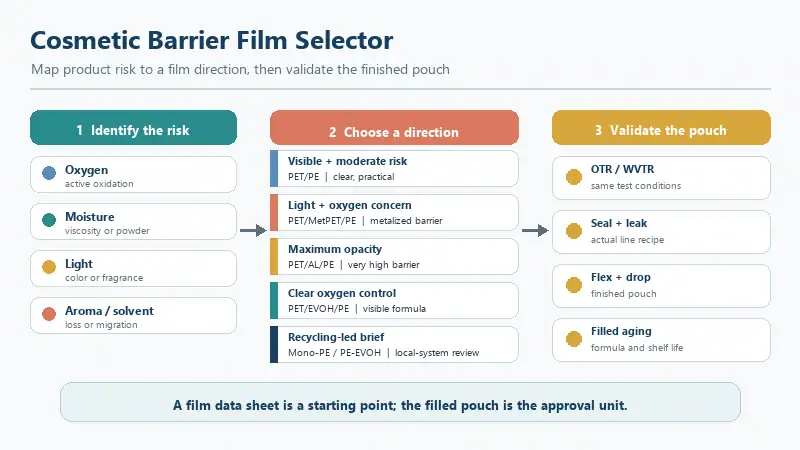
Use PET/PE or BOPP/PE when sensitivity is moderate and visibility, printability or cost matters. Consider PET/MetPET/PE when light and oxygen protection need to improve without using a full foil structure. Use PET/AL/PE when maximum light, oxygen and moisture protection is the priority. Evaluate PET/EVOH/PE when oxygen control and a clear appearance must coexist. Mono-PE or PE/EVOH/PE can support a recycling-led brief, but only after checking the local recycling system and the required barrier level.
Understand the layer system
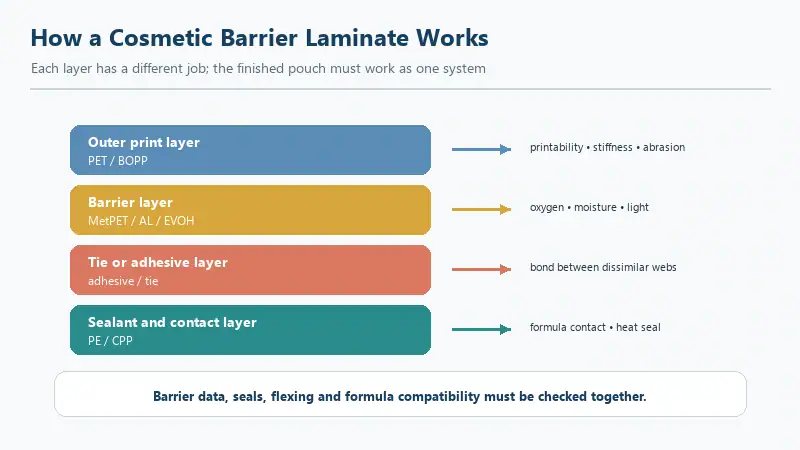
A pouch is a coordinated structure rather than one sheet. The outer PET or BOPP web provides printability, stiffness and dimensional stability. The barrier layer limits oxygen, moisture, light or aroma transmission. The inner PE or CPP layer contacts the formula and creates the heat seal. Adhesives or tie layers bond dissimilar webs. A spout, zipper, cap or tear notch adds another sealing and handling interface.
Compare common structures
| Structure | Typical direction | Key trade-off |
| PET/PE | Clear creams, lotions, cleansers and samples | Moderate gas and light protection |
| PET/MetPET/PE | Light-sensitive or aroma-sensitive products | Metallic appearance and flex-crack risk |
| PET/AL/PE | Sensitive actives, fragrance and long shelf life | Very high barrier but opaque and difficult to simplify |
| PET/EVOH/PE | Visible formulas needing oxygen control | EVOH performance changes with humidity and thickness |
| Mono-PE or PE/EVOH/PE | Refill and recycling-led projects | Local recycling acceptance and barrier must be confirmed |
Metallized PET is not a direct substitute for aluminum foil. Flexing, pinholes, coating quality and laminate design affect the actual barrier. EVOH is useful for oxygen control, but humidity and the surrounding polymer structure matter. Compare complete constructions under the same test conditions.
Match the film to the formula
Creams and lotions need chemical compatibility, puncture resistance and reliable seals. Serums with sensitive actives may need stronger oxygen and light protection. Fragrance-rich or alcohol-based formulas require aroma retention, solvent resistance and stable adhesive and sealant systems. Dry makeup samples need moisture protection, clean opening and resistance to fine-particle leakage. A flat sachet, stand-up pouch and spouted refill experience different stresses, so select the film with the final geometry and closure.
- Rank oxygen, moisture, light, aroma, solvent and contamination risks before asking for a quotation.
- State shelf life, storage temperature, distribution route, fill weight and whether the pouch is opened once or repeatedly.
- Decide whether the consumer should see the formula, fill level or only the printed brand surface.
Read OTR and WVTR correctly
OTR is oxygen transmission rate and WVTR is water vapor transmission rate. Lower values generally mean slower transmission through the tested specimen, but neither number guarantees finished-package shelf life. Record the unit, film thickness, temperature, relative humidity, conditioning time, test direction and method. Compare like with like, then check the finished pouch with the actual formula.
Treat seals and flexing as barrier performance
A film with excellent flat-film data can still leak through a weak seal. Seal initiation temperature, dwell time, pressure, line speed, wrinkles and product contamination influence the seal window. Spouted pouches also need film-to-spout and cap-fit checks. Pouches are folded, squeezed, stacked and shipped, so test gussets, corners, tear notches and spouts after flexing, compression, drops and temperature exposure.
Why a good film can still fail
Most approval problems happen at the edges of the specification rather than in the headline barrier number. A supplier may quote OTR or WVTR for a flat specimen at a humidity or thickness that does not match the finished pouch. The same structure can behave differently after printing, lamination, slitting, folding and sealing. A narrow seal window may work on a clean line but fail when cream reaches the seal area. Flex cracks can also appear around gussets or spouts after transport. Ask the supplier to connect each data point to the actual pouch geometry, filling recipe and distribution conditions.
Balance barrier and sustainability
Mono-material structures may simplify recycling, but they may not match the light, oxygen or moisture barrier of foil laminates. Clear films improve visibility; metallized or foil structures improve light blocking. A credible decision balances formula protection, material use, production waste, shelf-life loss and the recycling infrastructure in the target market. Do not make a broad recyclable claim until the final film, inks, adhesives, spout and cap have been reviewed.
Appearance is part of the technical brief. A clear pouch lets buyers see color, texture and fill level, but it can also expose sediment or shade variation. Metallized and foil structures create a stronger visual block and hide the formula, while an opaque printed web can sit between visibility and light protection. Decide what the consumer needs to inspect before selecting clarity, opacity and decoration.
Use a four-stage approval plan
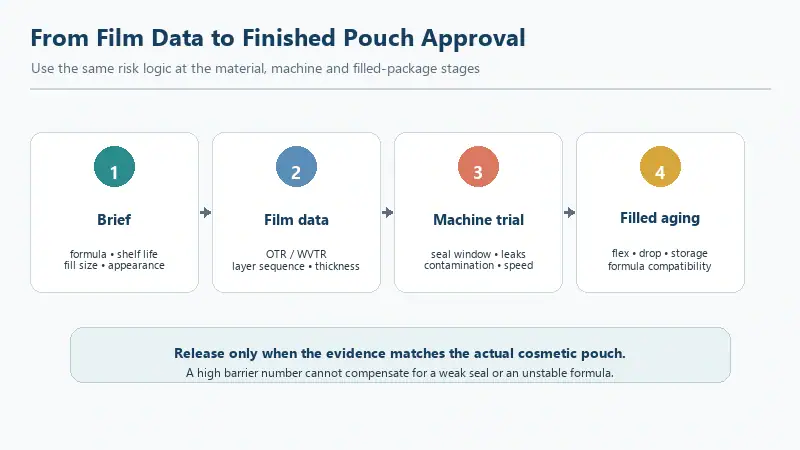
- Brief: formula, fill size, pouch style, shelf life, distribution and appearance.
- Compare: complete structures with layer sequence, thickness, sealant, OTR/WVTR data and test conditions.
- Trial: run the actual filling line and check web handling, registration, sealing, leaks and contamination tolerance.
- Validate: test filled pouches for seal strength, leak, burst, puncture, flex cracking, drop, storage and formula compatibility.
Write the purchasing specification
State the layer sequence, nominal thickness and tolerance, adhesive or tie-layer system, sealant, print side, surface treatment, barrier targets, seal-strength range, roll width, core size, artwork and pouch geometry. Request the exact construction drawing, test method, cosmetic-contact documentation, retained samples and change-notification rules. This prevents silent substitutions that alter sealing, appearance, barrier or recycling claims.
- Which complete structures meet the formula’s oxygen, moisture, light and aroma risks?
- What seal window and contamination tolerance can the film deliver on our line?
- What evidence supports the proposed recycling, PCR or mono-material claim in our target market?
- Which changes in resin grade, thickness, adhesive, ink or sealant would trigger a new qualification?
Explore flexible cosmetic packaging with SW Packaging
SW Packaging offers stand-up, spouted, three-side-seal, shaped, zipper, aluminum and eco-oriented pouch formats. Its pouch collection includes cosmetic options for creams, sunscreen, cleanser, samples and refill-style applications. The 30–50 ml resealable spout pouch is designed for controlled dispensing and travel use. For barrier structure review, filling-line samples or an OEM/ODM quotation, contact us with your formula and protection requirements.
Frequently Asked Questions
1. Is aluminum foil always necessary?
No. Foil is justified when the formula and shelf-life target require very high barrier and opacity. Clear, metallized or EVOH structures may be better when sensitivity is lower or visibility is important.
2. What should be tested before approval?
Test the filled pouch for barrier performance where relevant, seal strength, leaks, burst, puncture, flex cracking, drop, compression, odor transfer and formula compatibility. Confirm actual machine performance as well.
3. Can mono-material provide enough barrier?
Sometimes. PE/EVOH/PE can provide useful oxygen protection, but performance depends on humidity, thickness, sealant and local recycling acceptance. Approve the complete structure against the actual product risks.
The right cosmetic barrier film is the structure that protects the formula, seals reliably, survives real handling and supports a credible end-of-life plan at the required commercial cost.