
Choosing between rollstock film and pre-made pouches is a production decision, not only a packaging design decision. Rollstock is formed, filled and sealed on the line. Pre-made pouches arrive converted, then are opened, filled and sealed. The better route depends on volume per SKU, changeover frequency, equipment, pouch features, labor and the total cost of an accepted saleable unit.
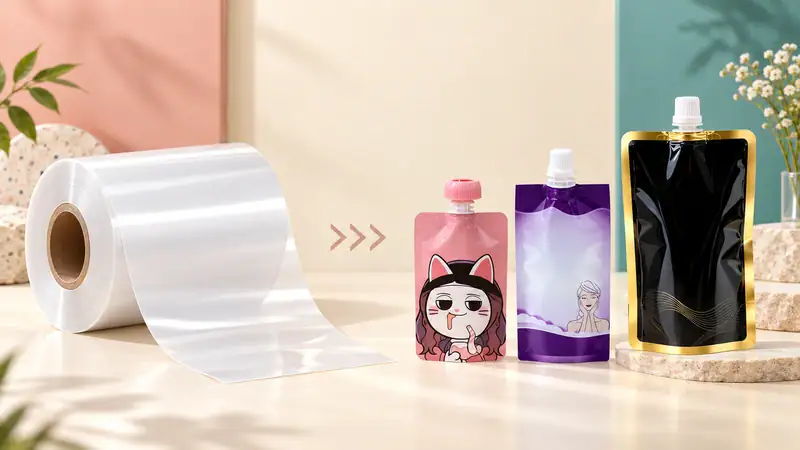
The short answer
Rollstock usually fits stable, high-volume SKUs that run for long periods on a compatible VFFS or HFFS line. Pre-made pouches usually fit launches, samples, multi-SKU programs and formats that need a stand-up base, zipper, spout or shaped profile. Neither route is automatically cheaper. The correct comparison is a line-ready total-cost model supported by a production trial.
| Decision factor | Rollstock film | Pre-made pouch |
| Best fit | Stable, high-volume SKUs with repeatable demand | Samples, pilots, many SKUs and special formats |
| Machine route | VFFS or HFFS forms, fills and seals the pouch | Pouch filler opens, fills and seals a converted pouch |
| Changeover | Roll, former, registration and seal settings may change | Pouch stack, guides and recipe usually change faster |
| Format range | Strong for standard sachets and repeatable seals | Strong for stand-up, zipper, spout and shaped pouches |
| Inbound logistics | Compact rolls before filling | Finished pouches need more storage space |
| Cost pattern | Lower package cost at suitable scale, with equipment and setup responsibility | Higher piece price, but less forming complexity on the filling site |
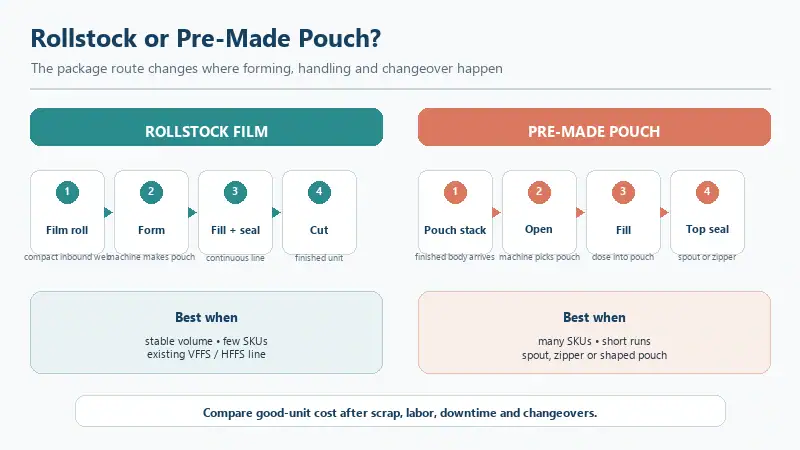
How the two routes work
With rollstock, printed and laminated film unwinds, forms around a collar or web path, receives the product, seals and cuts into individual packs. This continuous process can deliver high throughput, but film width, print repeat, web tension, coefficient of friction, forming settings and seal window must match the machine.
With pre-made pouches, the supplier has already printed, laminated, converted and sealed the pouch body. The filling line loads, opens and fills the pouch, then seals the top or closes the spout. This route can reduce forming work at the customer’s site and makes it easier to buy retail-ready features, but the finished pouches occupy more warehouse space and usually cost more per piece.
Choose rollstock when production is stable
Rollstock is a strong candidate when one or a few SKUs have predictable demand, the brand already owns compatible form-fill-seal equipment and long runs outweigh frequent changeovers. It can reduce package cost and inbound freight volume, especially for standardized sachets, sample packs or refill formats with simple seals. The trade-off is operational: forming equipment, tooling, trained operators, web setup and scrap remain part of the project.
- Stable artwork, dimensions and annual volume
- Existing VFFS or HFFS capacity and maintenance support
- High throughput and a clear cost-per-good-unit target
Choose pre-made pouches when flexibility matters
Pre-made pouches often make more sense for short runs, new launches, multiple shades or artwork variants, pilot programs and refill packs that need a zipper or spout. A brand can avoid adding a forming section and start with a pouch filler or co-packer. The trade-off is a higher quoted package price, SKU-specific minimum order quantities and the need to store finished pouches without damaging seals, gussets or printed surfaces.
- Many SKUs with moderate volume per SKU
- Fast launch timing or uncertain demand
- Stand-up, zipper, spout, shaped or premium shelf formats
Makeup samples and refill packs
Small makeup samples usually reward flexibility. A new shade set or campaign may need several artworks with limited volume, so pre-made sachets can avoid long rollstock changeovers and leftover printed film. A standardized sample produced at very high volume may still justify rollstock. Refill packs add another question: is the consumer expected to pour, squeeze or dose through a spout? If controlled dispensing and resealing matter, a pre-made spout pouch may create more value than its higher piece price.

Compare total cost, not the pouch quotation
Build the comparison around a good saleable unit. Include film or pouch price, printing plates, tooling, equipment investment, labor, line speed, changeover time, setup scrap, reject rate, freight, warehouse space, MOQ, maintenance and rework. Rollstock can look cheaper per square metre but lose its advantage when a line runs slowly or wastes film during setup. Pre-made pouches can look expensive per piece but win when they reduce capital, labor and changeover losses.
- Good-unit cost = total project cost divided by accepted filled units.
- Model the actual number of SKUs, annual runs and changeovers, not only annual units.
- Include the cost of inventory aging, artwork changes and damaged finished pouches.
Check equipment and changeovers
Share the machine model, film path, pouch dimensions, fill volume, target speed, seal style, product temperature and changeover pattern before asking for a recommendation. Rollstock may require a former, film-width change, registration setup and sealing adjustments. Pre-made equipment may require pouch magazines, opening tools, pick-and-place handling and guide changes. Published speed is not the same as sustained good-unit output; measure rejects, stops and changeover recovery.
Run a production-intent trial
Do not make the final decision from a generic sample or a unit-price spreadsheet. Run production-intent film or pouches on the actual line. Measure speed, fill accuracy, seal strength, leaks, reject rate, changeover time, labor and finished-unit cost. Also check opening, dispensing, cap or zipper retention, drop resistance, print registration and consumer handling. A short pilot often exposes problems that are invisible in a supplier sample.
Plan the next product stage
The best route at launch may not be the best route at scale. A brand can start with pre-made pouches for a pilot, then move a stable refill SKU to rollstock after volume, artwork and equipment are proven. Discuss this path early so the material structure, pouch dimensions and closure concept remain compatible with the next production stage.
Quality checks at the correct stage
For rollstock, inspect film thickness, splice quality, print registration, coefficient of friction and sealant performance before the line runs. For pre-made pouches, inspect dimensions, opening, seal strength, spout fit, zipper function and artwork alignment. For both routes, approve the filled pouch after sealing, transport and storage checks. Incoming material inspection alone cannot prove the performance of the finished package.
Practical scenarios
| Scenario | Likely starting route | Reason |
| One 100 ml refill, predictable demand, existing VFFS | Rollstock | Long runs and existing equipment can improve good-unit cost |
| Six sample shades for a new launch | Pre-made pouches | Short runs and artwork flexibility reduce setup risk |
| Travel refill that needs resealable dispensing | Pre-made spout pouch | The closure feature adds user value and avoids forming complexity |
What to send a pouch supplier
- Product viscosity, fill volume, temperature and formula contact requirements
- Pouch style, dimensions, seal layout, spout or zipper requirement and artwork
- Machine type, target speed, available line hours, annual volume and changeover pattern
- Target market, shelf presentation, MOQ, launch date and future scale plan
Find the right pouch route with SW Packaging
SW Packaging supplies stand-up, spouted, three-side-seal, four-side-seal, zipper, shaped, aluminum and eco-oriented pouches. The pouch category includes formats for cosmetic samples, travel packs and refill concepts. Its tiny gel sample pouch and 30–50 ml resealable spout pouch can be reviewed against your fill volume and line setup. For a film or pouch recommendation, pilot samples or an OEM/ODM quotation, contact Swpackaging with your machine details and production plan.
Frequently Asked Questions
1. Is rollstock cheaper than pre-made pouches?
It can be cheaper for stable, high-volume production, but the answer depends on machine efficiency, changeover time, scrap, labor, MOQ, freight and equipment cost. Compare accepted filled units, not only film or pouch price.
2. Which is better for cosmetic samples?
Pre-made pouches are often more flexible for multiple samples and short runs. Rollstock can make sense for one standardized sample produced at high volume on an existing line.
3. Can rollstock make stand-up pouches?
Some lines can form selected stand-up structures, but capability depends on equipment, film construction, pouch geometry and features. Confirm the exact design with a line trial.
The right choice is the route that delivers the required pouch format at the lowest reliable good-unit cost while keeping future volume, SKU changes and consumer use in view.