
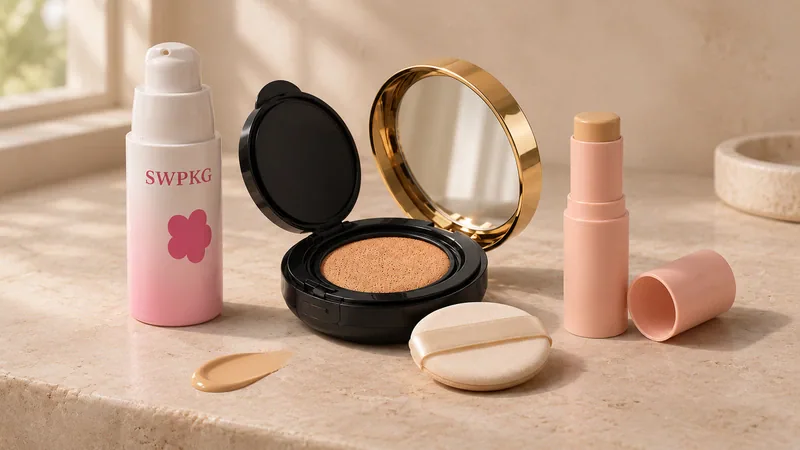
Choose foundation packaging by the way the formula needs to reach the skin. A liquid foundation needs a compatible dispensing system. A cushion needs controlled pickup through its reservoir and puff. A solid stick needs a holder that supports the formula during application. Start with that match, then compare appearance, filling requirements and cost.
For a brand launching several shades, the decision also affects component counts, shade identification and minimum order quantities. This guide compares the three formats and explains what to include in a sample request before you commit to decoration or a bulk order.
Compare the Three Foundation Packaging Formats
| Decision | Bottle | Cushion compact | Stick |
| Application | Dispense onto a hand or tool | Press with a puff and pat onto skin | Extend and apply directly |
| Formula requirement | Flow through the selected outlet | Load and release evenly from a reservoir | Retain shape while transferring to skin |
| Key components | Body, pump or closure and cap | Case, reservoir, inner closure and puff | Shell, mechanism, holder and cap |
| First filled check | Priming and dose consistency | Pickup and closure performance | Support, travel and cap clearance |
Use this comparison to shortlist samples, rather than to approve a formula. Two foundations described as liquid can behave differently in the same pump, and two stick formulas can need different support. Assess the complete filled pack with your formula developer and filler.
Give the Supplier a Usable Starting Brief
Share the formula type, intended net quantity, application routine and target market. Add the number of shades, order quantity by shade, preferred finish and launch date. If a filling partner is already selected, include its assembly and equipment constraints. These details make a sample recommendation more useful than a reference photo alone.
Choose a Bottle for Liquid Foundation
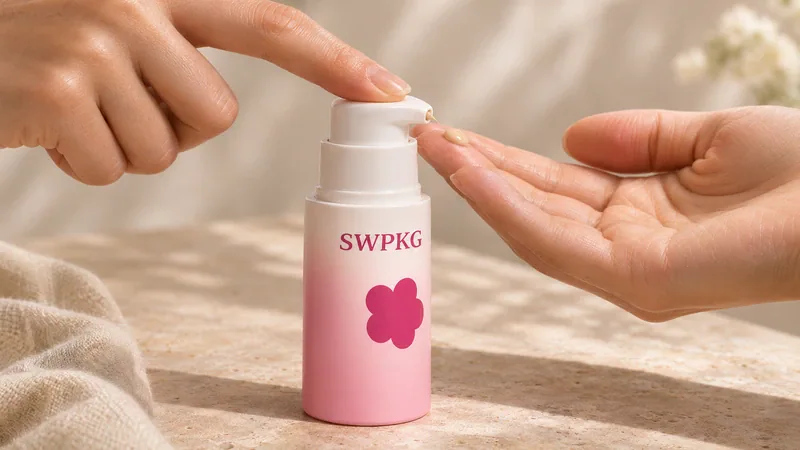
Match the Pump to the Formula
A pump bottle suits a dispensing routine where the customer applies foundation with a hand, brush or sponge. Check how many presses are needed before the first dose, the amount delivered per press and whether the outlet drips or accumulates product. Repeat the review after storage and as the pack empties.
An airless bottle is one option to evaluate. Confirm the internal system and formula suitability for the selected model; an airless description alone does not establish preservation, compatibility or complete evacuation. For a shake-before-use formula, ask whether the proposed structure allows the mixing routine your developer requires.
Confirm the Filling and Closing Sequence
Provide the intended net fill and ask the filler to check usable capacity, filling access and the space needed for closure assembly. Review the filled bottle for leakage in the agreed orientations and for dispensing changes after storage. If the body is transparent, assess the actual shade through the finished wall and decoration.
Our airless pump bottle range for liquid foundation is a starting point for sample discussions. Confirm the drawing and capacity of the specific version being quoted, since a product family can contain several sizes.
Choose a Cushion for Puff Application and Touch Ups
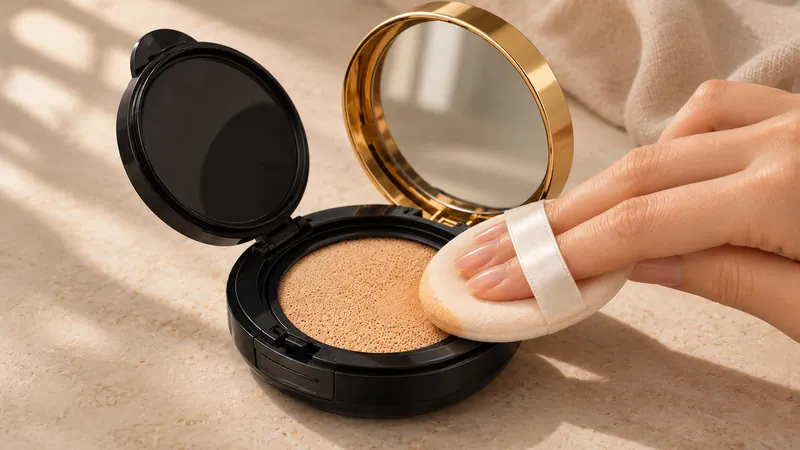
Approve the Reservoir and Puff as One System
A cushion compact works when the reservoir releases a usable amount of foundation under normal puff pressure. The formula, reservoir structure and puff all influence that result. Confirm whether the quotation includes the reservoir, puff, inner lid, seals and mirror, or only the outer case.
Evaluate pickup across the reservoir surface with the intended foundation and puff. Look for pooling, uneven loading and areas that become difficult to access as the product is consumed. Review the formula condition after the agreed storage and repeated-use periods. A compact that closes neatly still needs an assessment of drying and leakage with the actual formula.
Specify the Inner Assembly and Refill Route
Our BB cushion compact case provides a reference for the case and inner layout. Ask your filler how the reservoir will be loaded, the net fill checked and the inner assembly closed.
If refills are part of the launch, request a version designed for a replaceable insert. Confirm how the insert releases and seats, whether the case closes correctly after replacement and how the refill is protected before use. Price and identify the full compact and refill as separate purchase items. Do not assume a standard cushion case is refillable.
Choose a Stick for Direct Application
Match the Formula to the Holder and Mechanism
A foundation stick needs to retain its shape while transferring smoothly to skin. Define the target bullet diameter, application area and net weight before selecting the shell. External dimensions do not tell you the usable fill or the support provided by the internal holder.
Review the filled stick at its normal application height. It should remain seated while the mechanism advances and retracts it. Check for leaning, slipping, breakage and contact with the cap. Storage conditions and repeated application can reveal problems that an empty mechanism check will miss.
Confirm the Filling Method Before Decoration
Ask whether the selected component supports direct filling or needs a separately formed bullet. Agree the filling conditions with the filler and component supplier, then assess the cooled or installed formula. Avoid applying a generic filling temperature to a component whose materials and assembly have not been confirmed.
Our foundation and concealer stick container is one format to compare with your proposed core profile. Request the internal holder dimensions for the version you plan to sample.
A brush or sponge adds another component to specify. Clarify whether it blends product applied from the stick or receives liquid through a dispensing path. These are different package architectures.
Turn the Selected Format Into a Purchase Specification
Once you have shortlisted a format, give the supplier and filler the same component list. Record the model and revision, formula reference, net fill, decoration and the party responsible for each assembly step. Retain an approved filled sample alongside the drawing.
For a shade range, separate the total component quantity from the quantity for each color, print or label version. Ask which minimums apply to the base component and which apply to decoration. A common shell may simplify purchasing, but each shade still needs reliable identification on the container and any individual carton.
Compare quotations on the same scope: included components, decoration, assembly, protective packing and delivery terms. Confirm stock sample availability and the lead time for the exact configuration. Agree measurable acceptance criteria for appearance and function before releasing the order.
Request Foundation Packaging Samples From Somewang Packaging
Explore our face packaging range and contact Somewang Packaging with your formula direction, net fill, preferred format and quantity by shade. Include a reference pack or drawing when available. We can then discuss the components, drawings and sample options for your project.
Frequently Asked Questions
Can One Foundation Formula Work in All Three Formats
Do not assume it will. A pump needs flow through an outlet, a cushion needs controlled reservoir release, and a stick needs structural support. A format change should be reviewed with the formula developer and verified in filled samples.
Should Capacity Be Specified in Milliliters or Grams
State the net quantity in the unit you intend to sell. Weight and volume are related by the formula’s density; they are not interchangeable. Have the filler verify that quantity in the actual reservoir, bottle or holder.
Which Format Has the Lowest Cost
Compare the complete configuration at your order quantity. A compact may require a reservoir and puff; a bottle needs its dispensing parts; a stick needs its mechanism. Decoration, assembly, packing and filling requirements can change the comparison.