
An eyeshadow palette can look convincing in a product rendering yet disappoint once the pans, mirror and lid come together. A well-planned empty palette needs to hold the intended pans, open comfortably, protect the contents and carry the brand’s finish consistently. Those decisions also affect the minimum order quantity (MOQ) and the accuracy of a supplier’s quote.
For a beauty brand sourcing empty eyeshadow palette packaging, the most useful starting point is a clear component brief. This guide explains what to specify before requesting samples, from pan layout and retention to closure, hinge performance and order quantity.
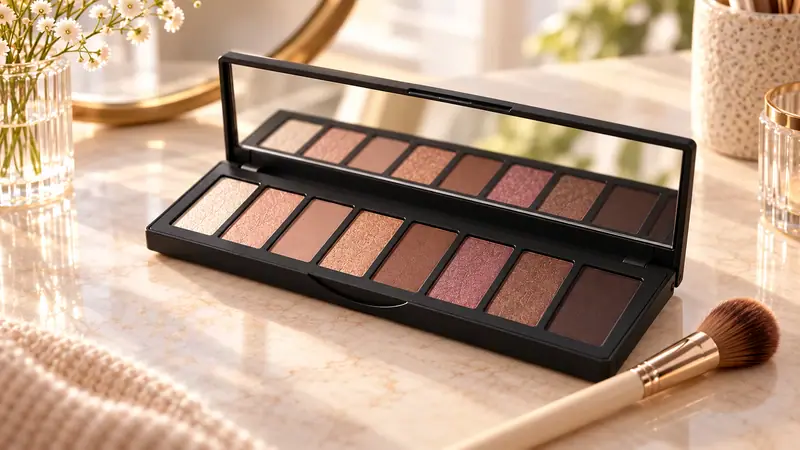
Begin with the empty case, not the shade names
A request for a “custom eyeshadow palette” can mean a filled makeup product or an empty case. State which one you need at the start. If you are buying packaging, provide the number and dimensions of the pans, the proposed fill weight, whether a mirror is needed, and how the finished product will be sold.
It also helps to describe the user experience. Will customers keep the palette in a handbag? Will makeup artists need to open it repeatedly at a work station? Is it a fixed collection or a refillable format? These answers influence the case footprint, pan spacing and closure more directly than the shade names do.
Somewang Packaging’s eyeshadow palette packaging range includes different pan counts and case formats. Use existing formats as a starting point, then identify which dimensions or features must change for your project.
Plan the pan layout around real dimensions
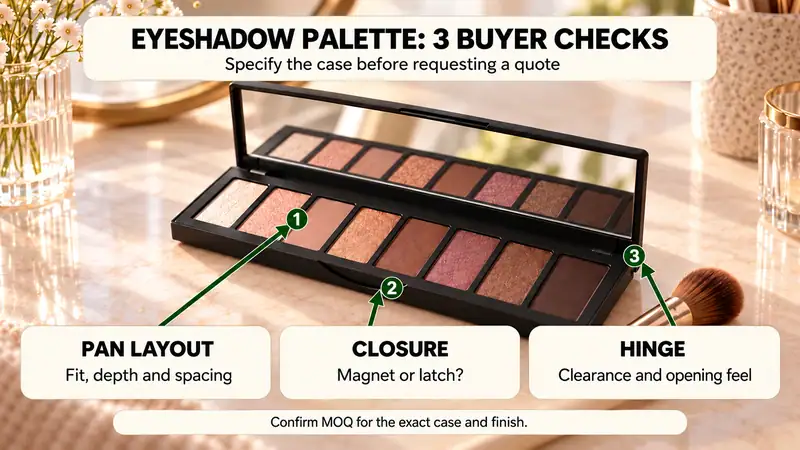
A pan layout is more than a count of empty spaces. The supplier needs the pan’s outside length and width, depth, corner shape and any manufacturing tolerance supplied by the formula or filling partner. A small difference can leave a pan loose or prevent it from seating flat.
Ask for a drawing that shows the cavity size, spacing between pans and distance from the outer edge. Leave enough room for users to reach each shade without striking the neighboring pan with a brush. If the palette combines eye and face products, confirm that the larger pans still leave practical space for the smaller ones. Also check the total thickness: deeper pans, a mirror and a slim outer case may compete for the same internal space.
An existing format can make the discussion concrete. Somewang Packaging’s eight-shade square palette with mirror provides one example of a rectangular, eight-position layout. A three-pan case with mirror illustrates a different approach for a smaller collection. The right choice depends on your actual pans and assortment, rather than the number of cavities alone.
Before approving a layout, place production-equivalent pans in a physical sample. Check that they sit level, that all shades remain accessible, and that the lid closes without touching the filled surfaces.
Specify what “magnetic” means
The word magnetic can describe two different palette features. A magnet may help hold the غطاء مغلق. In a refillable palette, magnets may instead help retain removable metal pans. One feature does not imply the other.
For a magnetic lid, define the desired closing feel and how securely it should stay closed during normal carrying. For removable pans, confirm the pan material and the retention system together. A magnetic base cannot retain every pan material, and a secure fit must still allow the intended user to remove a pan without damaging the case.
A conventional fixed-pan palette may use another retention method, while its lid closes with a latch. Ask the supplier to identify the actual construction of the proposed SKU. Do not approve a case on the assumption that a product described as “magnetic” has both a magnetic closure and refillable magnetic pans.
Check the hinge and mirror as part of the system
A palette is handled by its lid every time it is used. The hinge should open smoothly, reach a practical angle and keep the mirror useful at the intended position. An awkward opening angle can make a good-looking palette inconvenient on a dressing table.
Review a sample with the actual pans installed. Look for rubbing between lid and base, movement around the hinge, and any contact between the mirror or inner lid and the products below. Open and close the case repeatedly during sample review. Note whether the lid feels unstable, becomes loose or closes unevenly.
If the palette will travel, examine how the lid and closure work together when the case is carried in a bag. A strong closure cannot compensate for poor internal clearance, and a good hinge cannot compensate for a lid that opens unexpectedly. Treat them as one packaging system.
Choose the finish with the structure
A matte black case, a glossy custom color and a decorated logo can give the same layout very different results. Specify the case material, target color, surface finish and decoration method alongside the structural details. Ask to see a decorated sample, since a plain stock sample cannot show how the final logo and finish will look around edges and seams.
Review color under consistent lighting. Check that printing is placed correctly and remains legible when the case is open and closed. Inspect the visible edges, mirror installation and any surface that will rub during daily handling. If a presentation box is part of the launch, make sure it fits the finished, decorated case, not only an early unprinted sample.
The strongest purchasing brief describes one complete configuration. “Eight-pan palette” is a starting point; “eight-pan mirrored case in the approved color and finish, with the specified logo, closure and pack-out” is much closer to a quotable item.
Confirm MOQ for the exact configuration
MOQ is rarely useful without its conditions. An existing case, a new color, a special finish and a new mold can have different order requirements. Decoration may also have its own setup conditions. Ask whether the quoted minimum applies per case model, per color, per artwork version or across a combined order.
SW Packaging lists an MOQ on individual product pages, but that figure should be treated as SKU-specific, not as a promise for every custom palette. If your planned quantity is close to a minimum, discuss the precise specification early. A change in pan layout or construction may change both the quote and the MOQ.
Request a written quotation showing the case specification, decoration, sample route, quantity basis and what is included in the price. This makes later comparisons between suppliers and revisions more reliable.
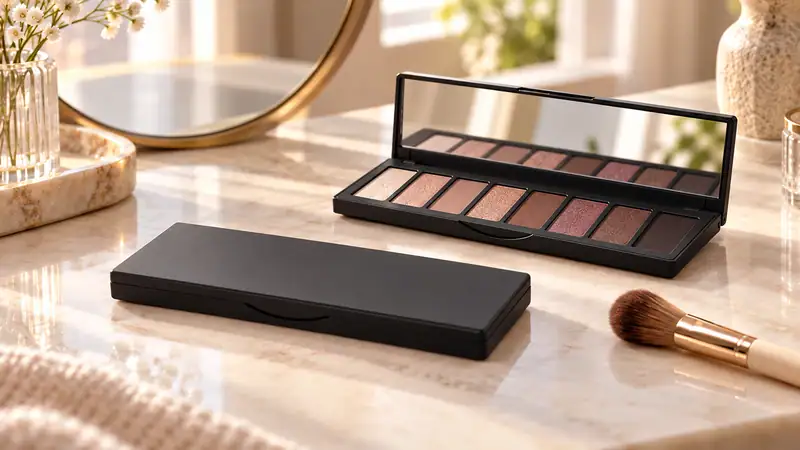
Approve a sample that answers the buying questions
A sample is most valuable when it represents the product you intend to order. Review it with production-equivalent pans and, where possible, the planned decoration. Record the results so that the approved sample can serve as a reference for the order.
Use a short checklist:
- Pan fit: Do all pans seat evenly and remain secure during normal handling?
- وصول: Can a brush reach each shade without unnecessary interference?
- Lid and hinge: Does the case open to a useful angle and close without rubbing?
- إغلاق: Does it remain shut during expected carrying while still opening comfortably?
- مظهر: Are color, logo position, mirror and visible surfaces consistent with the approved specification?
- التعبئة والتغليف: Does the completed case fit the proposed outer packaging?
If the brand is comparing multiple formats, test them with the same pans and review criteria. That makes the trade-offs between a compact case, a larger mirror and a different layout easier to see.
Prepare a brief Somewang التعبئة والتغليف can quote
Send the desired pan count and pan drawings, target case dimensions, mirror requirement, closure preference, material and finish, artwork, estimated order quantity and intended launch date. Mention whether you prefer an existing case or need a new structure. If a feature is undecided, label it as an option rather than leaving the supplier to assume.
Build the right palette with Somewang Packaging
The best empty palette is one that fits the pans, feels right in use and can be ordered at a workable quantity. Start with an existing format where it meets your needs, then confirm every requested change through a sample and a configuration-specific quote. Share your brief through صفحة اتصل بنا to discuss a suitable palette case.
الأسئلة الشائعة
- Will any eyeshadow pan fit an empty palette with the right pan count?
No. Match the pan’s outside dimensions, depth and shape to the actual cavities. Check the fit with production-equivalent pans, not the pan count alone.
- Is a magnetic closure the same as a magnetic refill system?
No. A magnetic closure holds the lid shut; a refill system retains removable pans. Confirm which feature the proposed case actually includes.
- What should I check in a palette sample?
Install the intended pans, then check their fit, access to each shade, mirror clearance, hinge movement and closure. Review the decorated finish on a complete sample.
- Will a custom layout or color change the MOQ?
It may. Ask for an MOQ based on the exact case, layout, color and decoration. An existing case and a newly tooled structure may have different requirements.